Design · 3.12
Migration in manageable steps
Time: about 11–14 minutes including the task; estimate
Guiding question: Which conditions permit the next migration step?
Learning objective: You plan migration states with approval and rollback criteria.
Prerequisites: Previous lessons through 3.11, particularly the case file developed there.
Transition is more than a date
Talbahn cannot convert every vehicle and route simultaneously. GSM-R and FRMCS coexist for a period. A schedule alone does not say which communication must be possible in each intermediate phase.
A migration state describes a defined scope of equipment, functions and permitted use. A transition criterion establishes the conditions under which the next state may be entered. It makes progress depend on a verifiable result. States A to E below are a Talbahn planning model, not prescribed FRMCS phases.
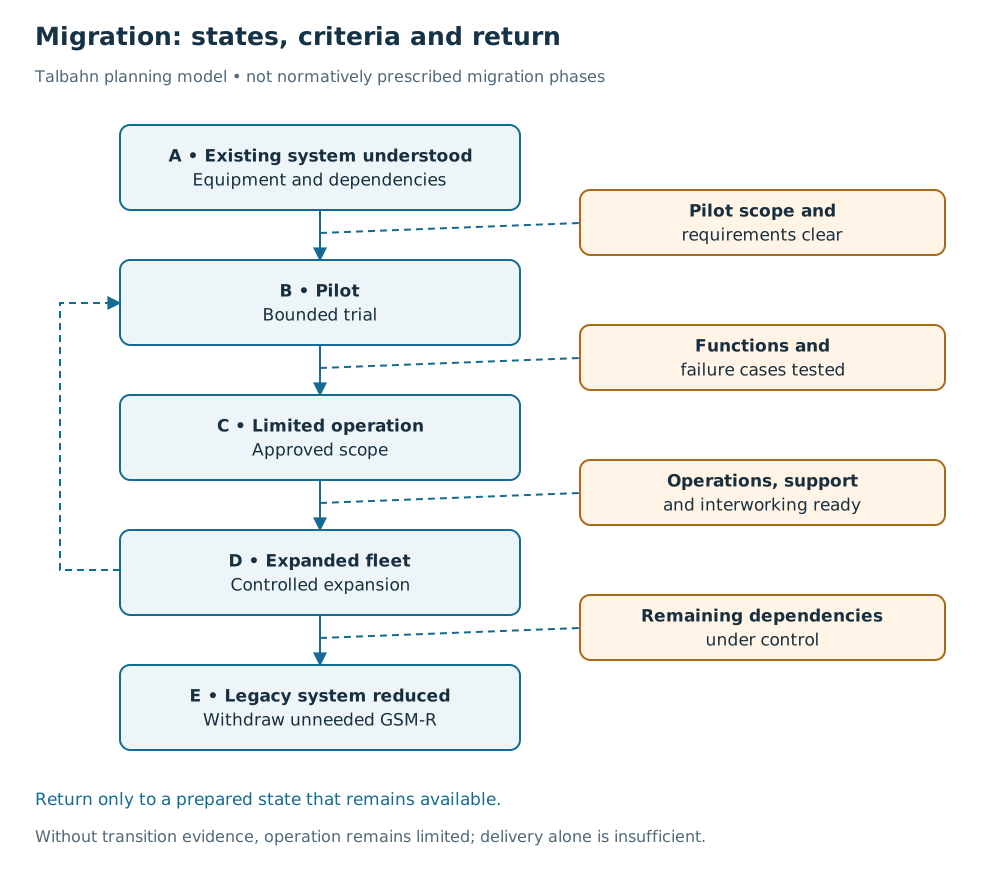
| State | Content | Prerequisite for the next step |
|---|---|---|
| A – Existing system understood | GSM-R assets, applications, dependencies and spare-parts risks recorded | Pilot scope and requirements approved |
| B – Pilot | Bounded FRMCS trial with named vehicles and locations | Functions, failure cases and responsibilities tested |
| C – Limited operation | Prepared operation within an expressly approved scope | Operations, support and mixed communication support the expanded scope |
| D – Expanded fleet | More vehicles and routes with controlled versions | Remaining GSM-R dependencies resolved or otherwise secured |
| E – Legacy system reduced | Unneeded GSM-R elements withdrawn under control | Continuing operational and change evidence |
No arrow automatically means “proceed”. A result may keep Talbahn in the current state until an open condition has been addressed.
Rollback must be possible beforehand
Rollback means controlled return to a previously defined state. It requires available equipment, suitable configurations, access rights, responsibilities and a rehearsed procedure.
After physical removal of GSM-R devices, “back to GSM-R” may no longer be possible quickly. Changed identity records can also make return difficult. Talbahn therefore reassesses rollback capability before every transition.
For state C, it defines this example: if an incorrect role assignment cannot be controlled, suspend the affected scope of operation and restore the previously approved communication state for that scope. The responsible operational parties decide whether vehicles may run, according to their rules. This teaching state is not an operating instruction.
Connect the timeline to the evidence plan
The central “Status and timeline” page shows external plans. Talbahn uses them for risks and dependencies, not as automatic approval of its next state.
An announced specification date may affect a procurement option. A supply contract may record an implementation date. The project transition still requires the agreed evidence. These three timelines must not merge into one supposedly certain commissioning date.
The case file gains decisions
For each transition, requirements, evidence, open risks, responsible approval and rollback prerequisites are brought together on one page. The missing IWF priority test from 3.10 may limit mixed operation while another FRMCS pilot purpose is already permitted.
Check your understanding
Project management wants to jump from B to D because ten additional vehicles have been delivered. Role handover has only been tested in the laboratory, and rollback for the new route is missing. What decision do you recommend?
Model answer
Delivery alone does not meet the transition criteria. I recommend limiting operation to the demonstrated scope. Before expansion, test the relevant role and route scenarios as well as operations, support and rollback prerequisites. The state must reflect substantiated capabilities, not the number of delivered devices.
What to remember
Demonstrated states make migration manageable; dates position these states in time.
Your Talbahn case file
Assign the current scope to a state from A to E. Name the transition evidence still missing and the prerequisites for a possible return.
Your progress is stored in this browser on this device.