Understand · 1.3
GSM-R and EIRENE: today's foundation
Time: about 14–17 minutes including the task; estimate
Guiding question: How do GSM-R and EIRENE connect the communication path to functional and technical requirements?
Learning objective: You explain the GSM-R communication path and the roles of the EIRENE FRS and SRS.
Prerequisites: Previous lessons through 1.2, particularly the case file developed there.
From conversation to connection
Lea speaks into the radio in the cab. Niko hears her at his control-centre workstation. More than an antenna lies between them. GSM-R stands for Global System for Mobile communications for Railways. It is a mobile communication system for railway voice and data tasks. [S02, S03]
A terminal is the device through which a user sends or receives information. Lea's radio captures speech and plays Niko's reply. The term identifies a technical role in the communication path, not a person.
Radio access provides the wireless connection between the mobile terminal and the network. A base station transmits and receives radio signals for this purpose. It provides the network-side radio contact with the terminal. Its coverage area is called a radio cell. Along a longer route, several such areas follow one another; the required coverage must also be provided inside the tunnel.
Behind radio access is the core network. Its functions organise connections, among other things, and support forwarding to the intended destination. The radio connection can therefore be usable while a call fails somewhere else. [S02, section 1.4]
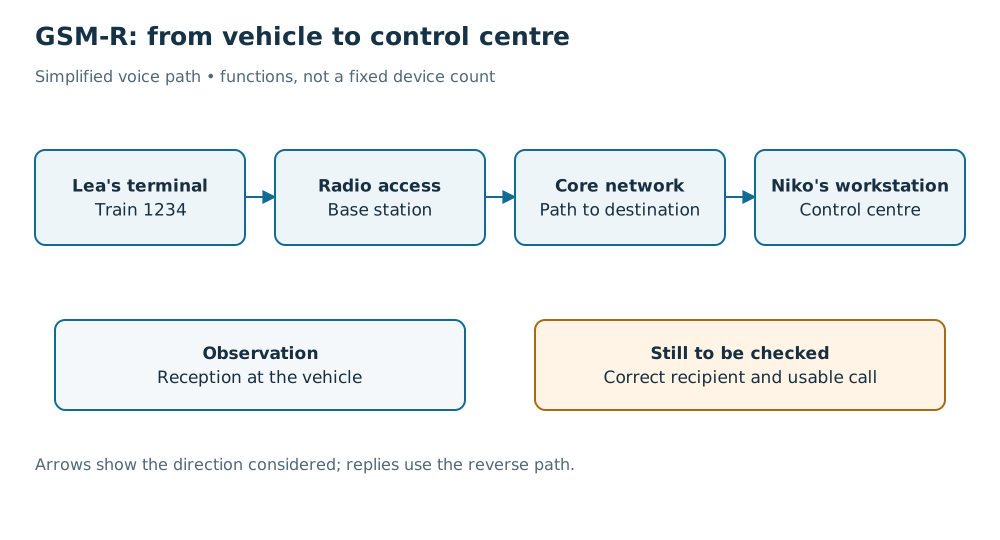
Read the diagram from Lea to Niko: the terminal uses radio access, followed by the core network and the control-centre connection. The arrows show the simplified communication path. They do not mean that each box is exactly one device or location.
A failure is not yet a cause
Consider an additional test at the station: Lea's device shows reception, but the call cannot be established. This does not contradict the earlier successful attempt; conditions or states may have changed.
The reception indicator describes a partial state. It proves neither Niko's reachability nor a defect in the radio. Investigation may start with the terminal, destination selection, network functions or control-centre connection. Permission to use the intended conversation must also be correct. Targeted evidence is needed to determine which explanation applies.
The same applies to measurement transfer from 1.2. Its functional endpoints are the applications. Radio access and the core network support transmission, but do not assess the condition of the measured component.
Comparing GSM-R and FRMCS
FRMCS also needs terminals, radio access and further network functions. However, the tasks are structured and implemented differently. The simple diagram helps compare their purpose; it is not a complete architecture of either system. EIRENE describes requirements for the GSM-R arrangement. [S01, S02, S07]
First establish what is needed
Niko wants to reach whoever is currently driving train 1234. That is a need. A requirement turns it into a needed capability or a condition against which a solution can be assessed. A teaching example is: “After confirmed role takeover, new role-based calls reach the new role holder.”
This wording is not complete yet. What exactly “confirmed” means and how two simultaneous registrations are handled must be established later. A visible open question is better than an apparently complete promise.
A specification records requirements and rules in an organised form. It gives the parties a shared reference for development and assessment. EIRENE stands for European Integrated Railway Radio Enhanced Network and here identifies the resulting family of requirements for GSM-R. GSM-R is the communication system; EIRENE is not another radio device. [S01, S02]
FRS and SRS answer different questions
The Functional Requirements Specification, or FRS, describes capabilities and behaviour from a functional perspective. For example, it asks which operational role must be reachable and what communication users need.
The System Requirements Specification, or SRS, describes requirements for the system and the interaction of its parts. For example, it covers functions and rules that enable functional destination selection. An SRS is not a finished design for a manufacturer's product. The boundary between the documents is not perfectly sharp in every paragraph either. [S01, S02]
This course consistently uses EIRENE FRS 8.1.0 and SRS 16.1.0 as teaching references. Requirements for a real project are also determined from the applicable framework and project agreements. “Included in the document” does not automatically mean “mandatory for every use”. [S16]
Separate implementation from evidence
The implementation consists of devices, software versions and settings. Two manufacturers can meet the same need differently. A button colour or product name does not show whether the required capability exists.
Evidence substantiates a claim under stated conditions. A test can show whether Niko actually reaches Amir after Amir's confirmed role takeover. A passed test does not automatically establish behaviour under conflicting registrations.
FRMCS also has functional and system requirements documents. Later we therefore compare the same capability on both sides, rather than comparing EIRENE as a document family with an FRMCS device. [S05, S06]
Optional background: GSM-R reference architecture
This optional background section expands the GSM-R map. It belongs to this lesson’s legacy-system example: Lea uses GSM-R here. The later pilot case in 2.20 explicitly uses different equipment: Lea has FRMCS and Amir has GSM-R. You do not need to memorise the following abbreviations at this introductory stage.
A BTS, Base Transceiver Station, is a GSM base station. It provides radio contact with the mobile device. A BSC, Base Station Controller, controls base stations and radio resources. It coordinates the radio access under its control. An MSC, Mobile Switching Centre, performs switching tasks for circuit-switched communication. It organises connections to the intended counterparts. These names describe functions or network elements; their physical distribution is a separate planning question. [S02]
Subscriber management provides information needed for participation and services. An HLR, Home Location Register, is a central subscriber database in the GSM system. It supports control decisions; it is not simply another station through which all speech must pass.
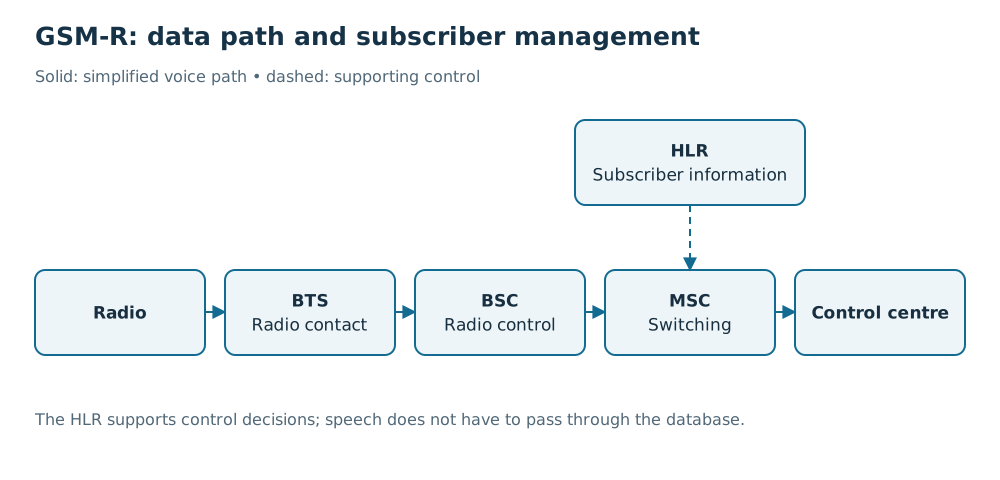
The solid connection shows a simplified voice path. Subscriber management at the side has a supporting relationship. The diagram thus distinguishes control from user information: control organises the exchange, while the user information here is the transmitted speech.
Why registration is not enough
Registration means that a participant has registered with a particular network or service and is known there in a corresponding state. The type of registration must be named. Network registration does not demonstrate correct registration to an operational function.
For example, Niko may reach a known subscriber number but not the current driver role. Communication is possible in principle. A first justified investigation concerns functional registration and destination resolution. Destination resolution maps a selected destination identifier to the participant actually to be contacted. An incorrect assignment state can cause a role-based call to fail.
This is a hypothesis, not a final root cause. A successful call to a subscriber number does not exclude every other fault; it helps narrow the next investigation.
GSM-R is not only voice
GSM-R also supports data communication. Circuit-switched and packet-switched approaches exist for ETCS; installed equipment and the agreed reference baseline determine actual use. IP within a GSM-R infrastructure does not automatically make it FRMCS either. [S02, S03]
For comparison with FRMCS, we therefore retain the tasks: radio access, subscriber permissions, connection and operational function. We do not merely replace old boxes with new names.
Check your understanding
Lea cannot reach Niko even though reception is indicated. Explain the three tasks of terminal, radio access and core network. Name two further parts or states whose operation the indicator does not demonstrate.
Model answer
The terminal captures and plays speech. Radio access connects it wirelessly to the network. The core network supports organisation and forwarding of the connection. Correct destination assignment and the control-centre connection, for example, remain unverified. The reception indicator also does not demonstrate the permissions needed for the call.
Additional application
Assign each of the following explicitly fictional, simplified statements to one category — FRS, SRS or test report — and justify your choice.
- A: “The signaller must be able to reach the driver currently responsible for train 1234.”
- B: “For a call to a train function, the system must use the currently valid mapping to the responsible driver’s communication destination.”
- C: “In the fictional Talbahn test, the call still reached Lea’s device after the driver change.”
Model answer
A: FRS – required operational function. B: SRS – required supporting system behaviour. C: test report – specific observation. These are teaching examples, not quoted standard requirements.
What to remember
- A connection needs several parts working together.
- Reception is partial evidence, not confirmation of a complete service.
- Observation and suspected failure cause are kept separate.
Your Talbahn case file
Add the network parts between both pairs of communication partners. In the failure case, mark what was observed and what remains unknown.
Sources
S01 · UIC EIRENE FRS
Version: 8.1.0 · Checked: 2026-10-11
Scope: Functional requirements: voice functions, groups, priority and functional addressing.
Limitations: Teaching reference; determine applicable requirements and MI markings for the project.
Used in: 1.1, 1.2, 1.3, 1.6
S02 · UIC EIRENE SRS
Version: 16.1.0 · Checked: 2026-10-11
Scope: Section 1.4 architecture; requirements for GSM-R system functions and addressing.
Limitations: No blanket statement about every installed GSM-R implementation.
Used in: 1.3, 1.5, 1.6, 1.8
S03 · ERA: European Rail Traffic Management System
ERA: European Rail Traffic Management System
Version: Web overview · Checked: 2026-10-11
Scope: Relationship between ETCS and railway communication.
Limitations: Orientation; use S18/S30 additionally for specific ETCS statements.
Used in: 1.1, 1.2, 1.3, 1.7
S05 · UIC FRMCS FRS FU-7120
Version: 2.1.0, 29 April 2025 · Checked: 2026-10-11
Scope: Functional requirements, identities, Functional Alias, voice and hazard communication.
Limitations: Teaching foundation, not evidence of complete product support.
Used in: 1.2, 1.3, 1.6, 2.7, 2.8, 2.15, 2.20, 3.2
S06 · UIC FRMCS SRS AT-7800
Version: 2.1.0, 30 April 2025 · Checked: 2026-10-11
Scope: System requirements, architecture, service/transport interaction and mobility. Functional Alias: 11.6/21.3; voice profiles: 24.2.3.3 and 24.3.3.2–4; TSCTRL: 6.4.1.3.
Limitations: The project baseline must specify the applicable parts.
Used in: 1.3, 2.4, 2.7, 2.9, 2.11, 2.13, 2.15, 2.16, 2.17, 2.18, 2.19, 3.2, 3.3, 3.16
S07 · ETSI TS 103 764: FRMCS System Architecture
ETSI TS 103 764: FRMCS System Architecture
Version: 1.1.1, January 2026 · Checked: 2026-10-11
Scope: Architecture sections: FRMCS boundary, service and transport, applications using the system.
Limitations: Course diagrams are original simplifications, not normative reference drawings.
Used in: 1.3, 1.5, 1.8, 1.9, 1.10, 2.1, 2.22
S16 · ERA: CCS TSI Appendix A – Mandatory specifications
ERA: CCS TSI Appendix A – Mandatory specifications
Version: ETCS B4 R1 / RMR GSM-R B1 MR1 & FRMCS B0 / ATO B1 · Checked: 2026-10-11
Scope: Reference list, especially EIRENE/ETCS entries and notes 7/9. FRMCS indices 092–095 and 099 each reference 1.0.0, not 2.1.0.
Limitations: Separate reference status from completeness and procurement readiness; the list is not itself the complete applicable law.
Used in: 1.3, 1.9, 2.11, 2.16, 2.17, 3.2, 3.15
Your progress is stored in this browser on this device.