Apply · 2.17
ATO over FRMCS
Time: about 7–10 minutes including the task; estimate
Guiding question: Which ATO relationships use FRMCS in the teaching case?
Learning objective: You explain ATO communication partners and the boundary of FRMCS provision.
Prerequisites: Previous lessons through 2.16, particularly the case file developed there.
Automated driving has its own communication partners
Automatic Train Operation (ATO) automates defined driving tasks. In the ATO-over-ETCS context considered here, ETCS retains its train-protection and supervision responsibilities. FRMCS supplies communication; it does not itself calculate the driving profile or permitted train movement.
ATO-OB denotes the on-board ATO part and ATO-TS the trackside part. They exchange information used for the planned journey, among other things. ATO-OB also interacts with on-board ETCS equipment and the vehicle. These relationships must not all be drawn as a single radio path. ERA lists separate specifications: SUBSET-125 for the system, SUBSET-126 for the ATO-OB/ATO-TS application interface and SUBSET-130 for ATO-OB/ETCS-OB. [S16; S51; S52]
Bound the FRMCS contribution
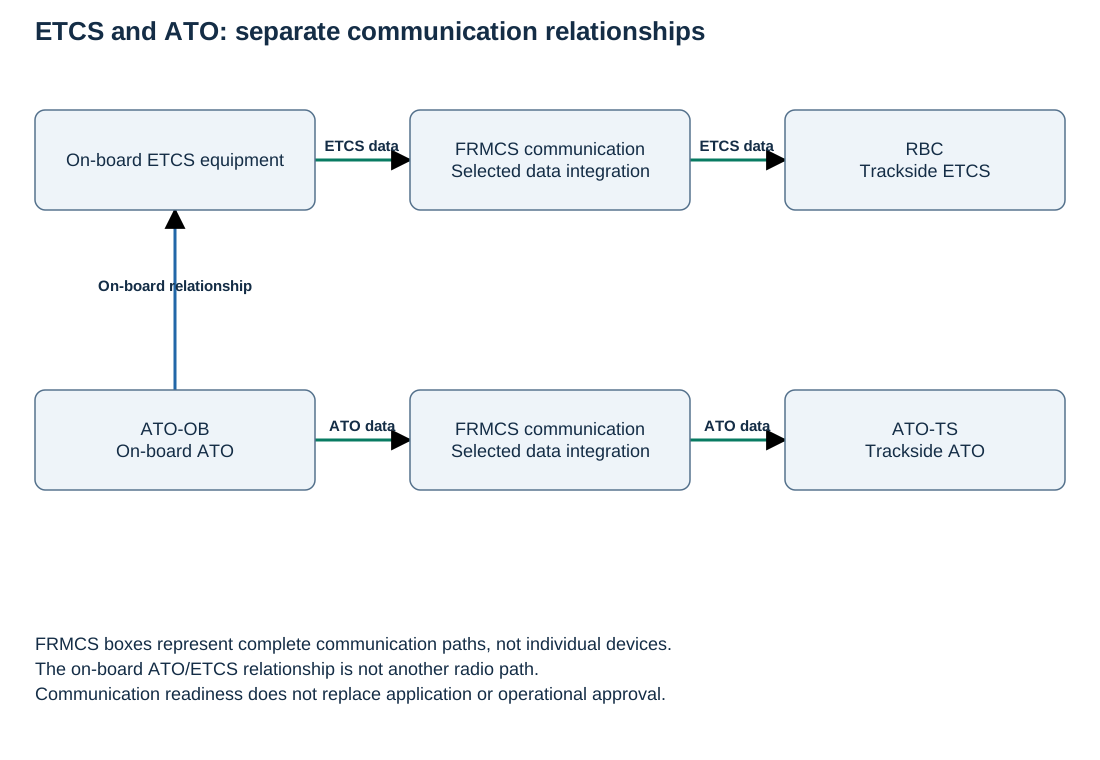
In the teaching case, ATO-OB exchanges data with ATO-TS through the defined FRMCS integration. The selected SRS assigns ATO to Host-to-Host addressing. The previously explained MCData communication helps us follow session and data path. ATO remains responsible for interpreting journey information. [S06, clause 6.5.2.3]
Talbahn therefore records two chains of states. The communication chain asks whether application and service are ready, whether a session exists and whether data arrives. The ATO chain asks whether the information is appropriate and usable for the current journey. A packet may arrive on time but belong to the wrong journey. Conversely, a transport problem may prevent the application from receiving necessary information.
Interruption from the application's perspective
Talbahn specifies which messages the trial expects and how freshness is assessed. It distinguishes absent communication from invalid or stale application data. The course supplies no universal braking or continued-driving rule. Permitted reactions follow the specific application, safety and operating basis.
For a network transition, Talbahn checks both continuation or recovery of the data service and resumption of the application exchange. Successful re-establishment without appropriate application states is not complete recovery. “ATO always needs FRMCS” would also be too broad: this lesson explicitly examines the selected ATO integration over FRMCS.
Check your understanding
After a connection change, FRMCS reports “session active” again. Is this sufficient to claim that ATO is fully operational?
Model answer
No. Correct partners, current journey association and usable application information also require evidence. On-board cooperation between ATO, ETCS and the vehicle remains a separate test subject. Communication readiness is a prerequisite for this exchange, not complete functional approval.
What to remember
ATO has its own application relationships. Its FRMCS communication must be explained separately from ETCS communication and internal vehicle interfaces.
Your Talbahn case file
Alongside the ETCS case, add a separate ATO case with partners, data purpose and two evidence categories: communication function and application processing.
Sources
S06 · UIC FRMCS SRS AT-7800
Version: 2.1.0, 30 April 2025 · Checked: 2026-10-11
Scope: System requirements, architecture, service/transport interaction and mobility. Functional Alias: 11.6/21.3; voice profiles: 24.2.3.3 and 24.3.3.2–4; TSCTRL: 6.4.1.3.
Limitations: The project baseline must specify the applicable parts.
Used in: 1.3, 2.4, 2.7, 2.9, 2.11, 2.13, 2.15, 2.16, 2.17, 2.18, 2.19, 3.2, 3.3, 3.16
S16 · ERA: CCS TSI Appendix A – Mandatory specifications
ERA: CCS TSI Appendix A – Mandatory specifications
Version: ETCS B4 R1 / RMR GSM-R B1 MR1 & FRMCS B0 / ATO B1 · Checked: 2026-10-11
Scope: Reference list, especially EIRENE/ETCS entries and notes 7/9. FRMCS indices 092–095 and 099 each reference 1.0.0, not 2.1.0.
Limitations: Separate reference status from completeness and procurement readiness; the list is not itself the complete applicable law.
Used in: 1.3, 1.9, 2.11, 2.16, 2.17, 3.2, 3.15
S51 · UNISIG SUBSET-125: ERTMS/ATO SRS
UNISIG SUBSET-125: ERTMS/ATO SRS
Version: 1.1.0 · Checked: 2026-10-11
Scope: ATO system and functional relationships.
Limitations: Named teaching edition; no blanket product or project approval.
Used in: 2.17
S52 · UNISIG SUBSET-126: ATO-OB / ATO-TS application layer
UNISIG SUBSET-126: ATO-OB / ATO-TS application layer
Version: 1.1.0 · Checked: 2026-10-11
Scope: Application relationship between ATO-OB and ATO-TS.
Limitations: Named teaching edition; no blanket product or project approval.
Used in: 2.17
Your progress is stored in this browser on this device.