Apply · 2.20
Interworking Function: connecting FRMCS and GSM-R
Time: about 10–13 minutes including the task; estimate
Guiding question: How does the IWF translate a mixed call and which limitations shape migration?
Learning objective: You explain IWF translation, limitations and impact on migration.
Prerequisites: Previous lessons through 2.19, particularly the case file developed there.
A separate mixed-system test case
In the next pilot test, Lea drives FRMCS train 1234; Amir drives GSM-R train 5678. This is a separate test case: it does not continue Amir's takeover of the role on train 1234 in 2.7. Niko wants to reach both vehicles in a common call. Coexistence from 1.10 initially means only that both systems operate in parallel. A common call additionally requires their communication functions to work together.
The IWF connects functions across the system boundary
An Interworking Function (IWF) mediates the explicitly supported communication functions between FRMCS and GSM-R. It maps identities and control information as required and enables the intended media exchange. On the FRMCS side it works with the responsible MC service functions; on the GSM-R side it works with the designated voice and signalling functions. ETSI TS 103 792 describes reference points, identity mapping and call procedures for this purpose. [S11, clauses 5–7]
The Mobile Switching Centre (MSC) performs switching tasks in the GSM-R core. It organises connections there; the IWF does not replace that network. The Trackside Gateway from 2.12 also has a different responsibility: it connects applications to FRMCS. The IWF instead mediates between two communication systems. You can revisit GSM-R network elements in the optional background section in 1.3.
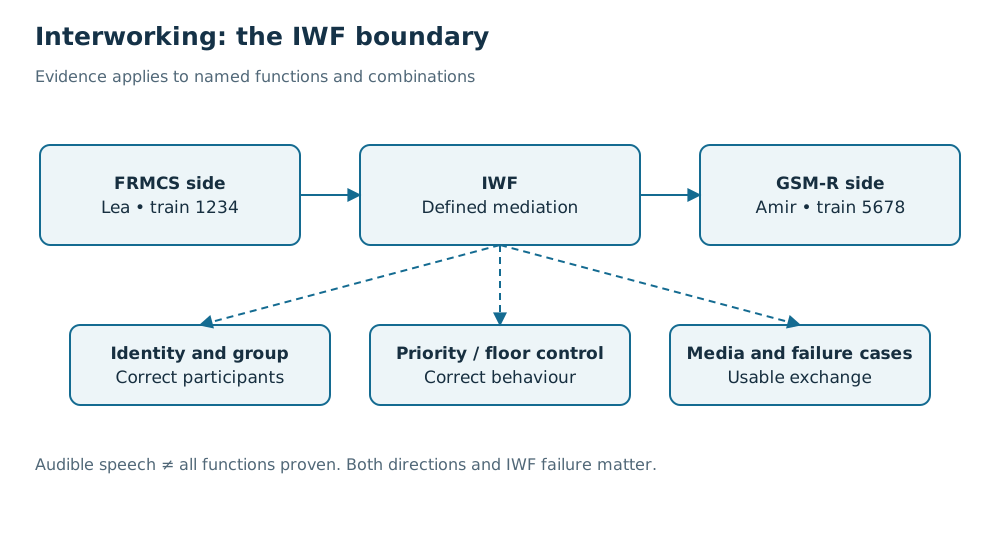
Read the diagram as a functional boundary. Identities and groups, priority and floor control, and media and failure behaviour each require appropriate handling. The drawing does not promise that every offered IWF supports every function.
Follow a mixed-system call
Niko requests the call with Lea and Amir. The FRMCS side handles the participant selection required there. For the GSM-R portion, target identities and call criteria must be mapped onto the supported GSM-R procedure. An FRMCS participant list must not be equated with a GSM-R group identifier without checking. Both systems handle their respective call states; the IWF mediates the designated control information and media.
After setup, Niko hears both vehicles. Speech has therefore been observed in this test. Complete recipient selection, the required priority treatment and behaviour during a later floor change have not yet been demonstrated. The IWF consequently does more than connect audio, and audible speech is only partial evidence.
| Function | Evidence question |
|---|---|
| Target and identity | Is the operational target correctly mapped onto the other side? |
| Participants and group | Do setup and changes reach the intended participants? |
| Priority | Is the required treatment maintained across the boundary? |
| Floor control | Is it unambiguous who may speak and when? |
| Media | Is speech intelligible in both directions? |
| Failure and follow-up | Is a fault detected, and is the intended callback or alternative path possible? |
Talbahn tests both initiation directions: a call starting on the FRMCS side and on the GSM-R side. It also considers late entry into an ongoing call and call termination where included in the agreed scope. Products, versions and configurations are named for these tests. An ordinary mixed group call does not automatically demonstrate the special recipient and priority conditions of railway emergency communication. [S05; S11]
Prepare an alternative path
An alternative path for failure conditions is a prepared way to achieve a defined purpose under specified failures. It needs available equipment, valid permissions and an approved procedure. If the IWF fails, the two networks may continue separately while the mixed call fails. Whether this holds for the actual architecture also depends on shared functions.
“Everyone will then use GSM-R” is viable only if the participants have the necessary equipment and permissions. It does not give a purely FRMCS vehicle GSM-R capability. The case file therefore records fault detection, affected communication, responsibility for the decision and the tested alternative path. Without it, the operating condition remains unresolved.
Why the IWF affects migration
While both systems operate in parallel, the IWF can enable a required common communication environment. Its availability, capacity and functional limits help determine which mixed operational cases can be approved. Once one system is switched off, this particular interworking relationship is no longer needed. Until then, it still needs demonstrated operation and planned withdrawal. In 3.10 this becomes a function-and-evidence matrix; 3.12 links it to migration states.
Check your understanding
Lea and Amir hear each other in the mixed call. Priority mapping and late entry have not been tested. What is demonstrated, what evidence is missing, and why can IWF failure differ from failure of FRMCS radio access?
Model answer
The observed media communication of the tested combination is demonstrated. Priority and late entry need separate tests; other identity and call states are established only to the extent actually tested. An IWF fault may affect the system boundary while internal FRMCS communication continues. Missing radio access instead affects the FRMCS users connected through it. Shared functions and the prepared alternative path also need checking.
What to remember
The IWF mediates defined functions at the FRMCS/GSM-R boundary. Its actual scope, failure impact and alternative path help determine viable migration steps.
Your Talbahn case file
Identify Lea in FRMCS train 1234 and Amir in GSM-R train 5678. Record identities, call states, media, priority and IWF failure as separate checks. Explicitly mark functions not yet demonstrated.
Sources
S05 · UIC FRMCS FRS FU-7120
Version: 2.1.0, 29 April 2025 · Checked: 2026-10-11
Scope: Functional requirements, identities, Functional Alias, voice and hazard communication.
Limitations: Teaching foundation, not evidence of complete product support.
Used in: 1.2, 1.3, 1.6, 2.7, 2.8, 2.15, 2.20, 3.2
S11 · ETSI TS 103 792: FRMCS/GSM-R Interworking
ETSI TS 103 792: FRMCS/GSM-R Interworking
Version: 1.1.1, January 2026 · Checked: 2026-10-11
Scope: Interworking architecture and defined functional mediation.
Limitations: Demonstrate support per function and combination; not universal ETCS translation.
Used in: 1.10, 2.7, 2.20, 2.22
Your progress is stored in this browser on this device.