Apply · 2.16
ETCS over FRMCS
Time: about 9–12 minutes including the task; estimate
Guiding question: Which communication task does FRMCS perform in the selected ETCS case?
Learning objective: You explain the selected ETCS communication chain over FRMCS.
Prerequisites: Previous lessons through 2.15, particularly the case file developed there.
A different purpose from voice
Lea and Niko exchange spoken information in a group call. In ETCS, on-board and trackside computers are among the communicating parties. ETCS performs train-protection tasks: under defined conditions, it supervises whether a train remains within its permitted movement. FRMCS provides communication for this.
A Radio Block Centre (RBC) is a trackside ETCS entity. It processes the train and infrastructure information intended for its remit and, in particular, transmits movement authorities to ETCS on-board equipment. Talbahn must therefore not confuse a reachable RBC computer with an already valid movement authority.
Euroradio means the communication defined for ETCS, including its intended protection and connection functions. It establishes the relationships needed in the ETCS context over an underlying transmission system. The name means neither ordinary voice radio nor “any radio connection on a train”. [S18, S30]
Adapting to a new transport
A baseline is a defined, coherent set of specifications. ETCS Baseline 4 therefore describes a specification foundation, not merely new software on one device.
ERA's reference list for ETCS B4 R1 includes SUBSET-037-1 for communication and coordination, SUBSET-037-2 for the safety layer, and SUBSET-037-3 for the FRMCS interface. It makes ETCS adaptation to FRMCS concrete. The applicable version in a vehicle project and the functions actually available must nevertheless be established separately. [S16, S30]
For Talbahn this creates three different checks: does ETCS equipment support the required baseline? Does the FRMCS connection provide the required communication capabilities? Do both work together in relevant operational and failure cases? One successful data transfer does not answer all three questions.
The boundary in the case file
Talbahn writes: “On-board ETCS equipment exchanges messages with the responsible RBC through the agreed communication chain.” Alongside this it records requirements for reachability, interruption and evidence. Decisions about permitted train movement remain with the intended ETCS functions and operating rules.
The concrete ETCS communication chain
We examine exchange between on-board ETCS equipment and the responsible RBC over an FRMCS integration designed for that purpose. Communication functions connect application endpoints; they do not decide the content of movement authorities. This course's data chain uses the previously explained service-controlled IP communication and associated trackside integration. The SRS assigns ATP applications to the H2H approach. ATP means Automatic Train Protection; ETCS is such a train-protection system in the European context. [S06, clause 6.5.2.3; S30]
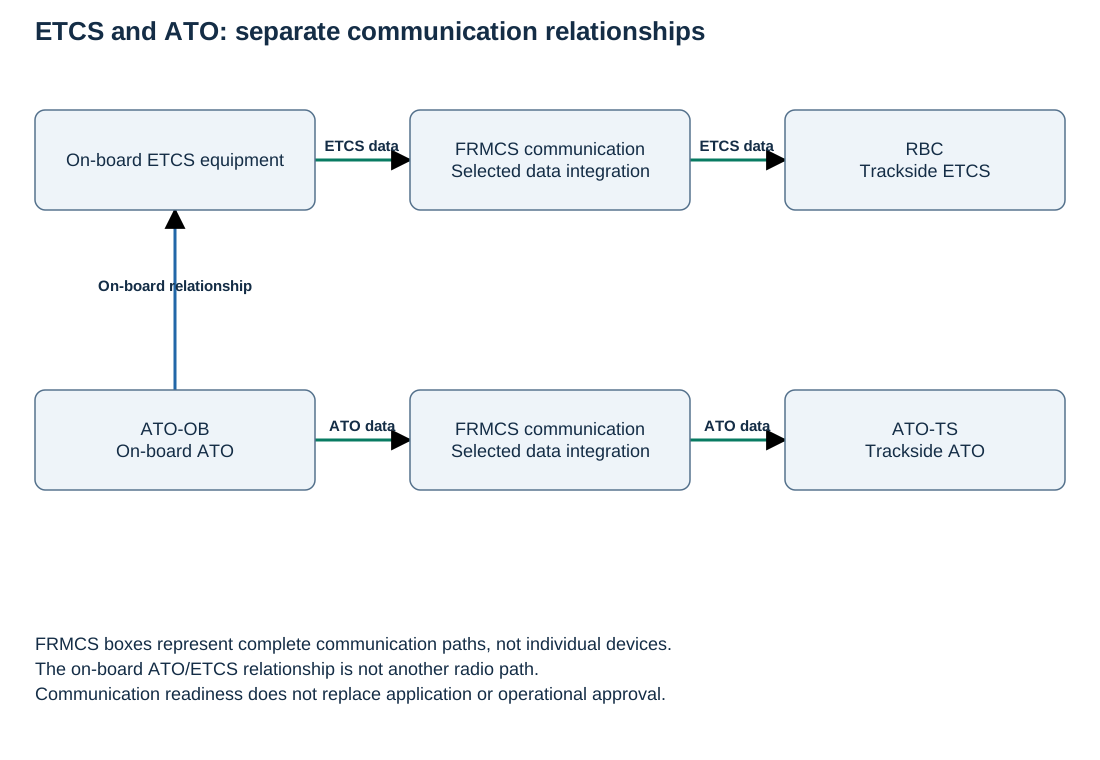
Talbahn follows three boundaries: on-board ETCS/FRMCS integration, the communication-system data session, and delivery to trackside ETCS. It then checks application processing. A successful ping, a simple IP reachability test, does not cover this chain. Installing a radio module likewise establishes nothing about the complete Euroradio and application baseline.
On communication loss, detection in the communication system, notification to the application and the ETCS response are separate activities. Timing and operational responses come from the applicable system and operating framework. This lesson invents no universal braking rule. It also does not claim that every ETCS configuration necessarily requires FRMCS.
Check your understanding
A manufacturer says: “FRMCS is installed, so the vehicle is ready for ETCS Baseline 4.” Which missing chain do you identify?
Model answer
Installed transport demonstrates neither the ETCS equipment baseline, nor the appropriate Euroradio/FRMCS connection, nor their interaction. A defined specification baseline, demonstrated implementations and tests of the specific vehicle, trackside and communication combination are required. ETCS and ATO remain applications with their own tasks and evidence.
What to remember
A new communication path replaces neither application adaptation nor its safety evidence.
Your Talbahn case file
Draw communication between ETCS on-board equipment and the RBC. Separate the ETCS baseline, FRMCS connection and evidence of their interaction.
Sources
S06 · UIC FRMCS SRS AT-7800
Version: 2.1.0, 30 April 2025 · Checked: 2026-10-11
Scope: System requirements, architecture, service/transport interaction and mobility. Functional Alias: 11.6/21.3; voice profiles: 24.2.3.3 and 24.3.3.2–4; TSCTRL: 6.4.1.3.
Limitations: The project baseline must specify the applicable parts.
Used in: 1.3, 2.4, 2.7, 2.9, 2.11, 2.13, 2.15, 2.16, 2.17, 2.18, 2.19, 3.2, 3.3, 3.16
S16 · ERA: CCS TSI Appendix A – Mandatory specifications
ERA: CCS TSI Appendix A – Mandatory specifications
Version: ETCS B4 R1 / RMR GSM-R B1 MR1 & FRMCS B0 / ATO B1 · Checked: 2026-10-11
Scope: Reference list, especially EIRENE/ETCS entries and notes 7/9. FRMCS indices 092–095 and 099 each reference 1.0.0, not 2.1.0.
Limitations: Separate reference status from completeness and procurement readiness; the list is not itself the complete applicable law.
Used in: 1.3, 1.9, 2.11, 2.16, 2.17, 3.2, 3.15
S18 · UNISIG SUBSET-023: ERTMS/ETCS Glossary
UNISIG SUBSET-023: ERTMS/ETCS Glossary
Version: 4.0.0 · Checked: 2026-10-11
Scope: ETCS, RBC and associated terminology.
Limitations: Terminology reference, not complete ETCS system training.
Used in: 1.7, 2.16
S30 · ERA: Euroradio SUBSET-037-1/-2/-3
ERA: Euroradio SUBSET-037-1/-2/-3
Version: 4.0.0 in the ETCS B4 R1 reference set · Checked: 2026-10-11
Scope: Communication and coordination; supplementary parts -2 safety layer and -3 FRMCS interface: see S16.
Limitations: Distinguish this reference edition from later development versions. Not a complete ETCS safety profile.
Used in: 2.16
Your progress is stored in this browser on this device.