Apply · 2.5
SIP and IMS in the FRMCS context
Time: about 8–11 minutes including the task; estimate
Guiding question: How do registration, session control and media transfer differ?
Learning objective: You read a simplified SIP exchange and place IMS functions in context.
Prerequisites: Previous lessons through 2.4, particularly the case file developed there.
Why a call needs control information
Lea wants to reach Niko. Before usable speech can be exchanged, software functions must establish a session and agree suitable media conditions. SIP, the Session Initiation Protocol, carries requests and responses for this purpose. IMS, the IP Multimedia Subsystem, is an architecture organising SIP-based services. SIP is a protocol; IMS describes cooperating functions. [S21]
A SIP User Agent is software that generates or answers SIP requests. A proxy forwards requests according to routing rules. A registrar processes registrations and associates a SIP address with a current contact address. Registration therefore supplies reachability information; it is not a conversation.
Place IMS functions in context
IMS terminology includes P-, I- and S-CSCF. CSCF means Call Session Control Function. The Proxy-CSCF (P-CSCF) is the first SIP contact point on the IMS side; the Interrogating-CSCF (I-CSCF) supports selecting or locating the responsible control function when entering a home network; the Serving-CSCF (S-CSCF) performs central registration and session-control tasks. An Application Server executes service-specific logic. These names describe logical responsibilities, not necessarily separate devices. [S49, clause 4]
For FRMCS we examine the specified SIP Core and its MCX integration. An arbitrary IMS product does not automatically meet the required FRMCS profile. The general IMS functional view must therefore be mapped to the actual interfaces and procedures used. [S09, clause 5.1.2]
Read a SIP exchange
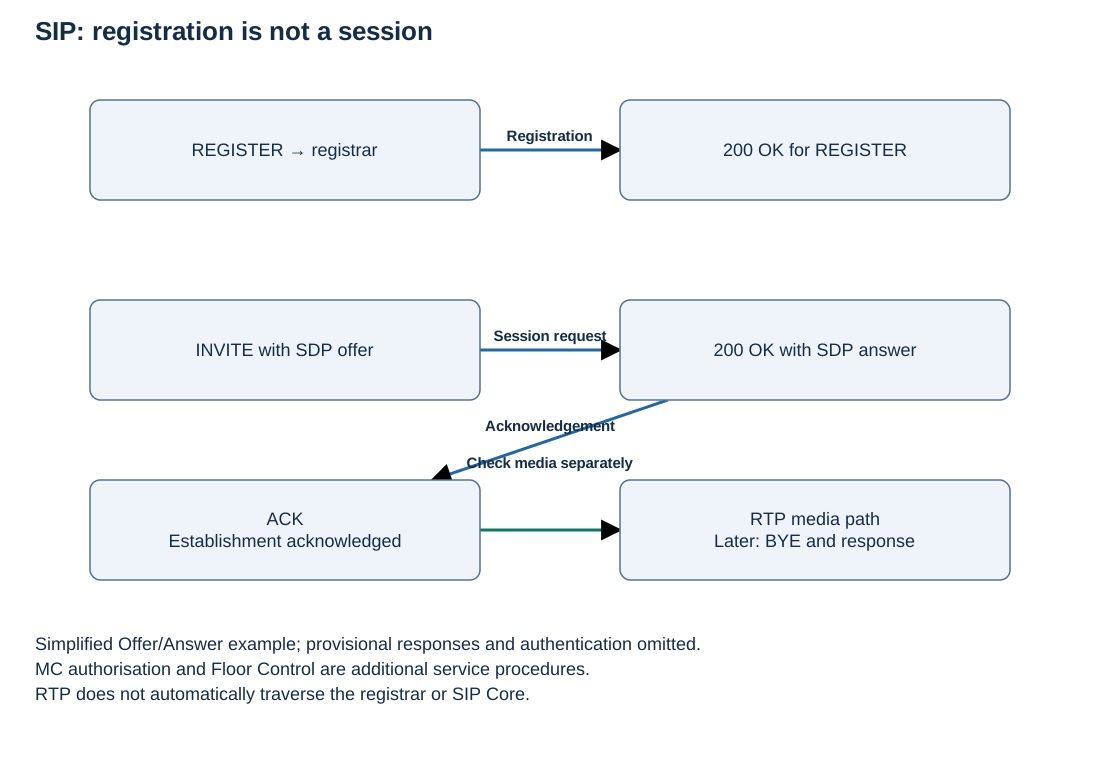
The teaching sequence shows a SIP session, not yet a complete railway-specific call. REGISTER establishes or renews SIP registration. Successful registration does not automatically authorise every MC service. INVITE requests a session; a 1xx response reports a provisional state. 200 OK is a successful final response to the particular request. ACK acknowledges the successful INVITE response. BYE terminates an established session. CANCEL instead cancels a pending request and does not replace BYE. [S21]
SDP, the Session Description Protocol, describes media parameters such as media type and codec offers. A codec defines how audio is represented digitally. With Offer/Answer, one side offers parameters and the other responds with a compatible selection. SDP does not carry speech itself. RTP provides time-related media transport in the voice example. The voice lesson adds the specific MCPTT procedures. [S22; S43; S44]
Do not confuse three registrations
Mobile-network registration initially permits use of the network. SIP registration establishes SIP reachability. MC service authorisation determines permitted service access. During diagnosis, associate each confirmation with its procedure. A SIP 200 OK for REGISTER is not successful call establishment; a 200 OK for INVITE does not demonstrate received audio.
Check your understanding
A capture contains successful REGISTER and later INVITE, 200 OK and ACK. Niko still hears nothing. What is demonstrated, what is missing, and why examine media parameters?
Model answer
The observed registration and successful SIP establishment segment are demonstrated. Service-specific permission to speak, the appropriate media flow and audio output still need verification. Media parameters help establish whether sender and receiver use compatible audio formats and the correct reception path. They do not by themselves prove packet arrival or loudspeaker operation.
What to remember
SIP controls sessions, SDP describes media conditions and RTP carries voice media. IMS organises control functions; MCX adds service-specific behaviour.
Your Talbahn case file
Create a trace recording message, procedure, sender, receiver and evidential limits. Record the three registration states separately.
Sources
S09 · ETSI TS 103 765-2: FRMCS Service Stratum
ETSI TS 103 765-2: FRMCS Service Stratum
Version: 1.1.1, January 2026 · Checked: 2026-10-11
Scope: Service architecture; SIP Core definition; registration and MC services.
Limitations: Do not equate IMS with SIP; the architecture allows the specified SIP Core alternatives.
Used in: 1.9, 2.1, 2.4, 2.5, 2.6, 2.7, 2.8, 2.9, 2.10, 2.14, 2.19, 2.22, 3.5, 3.16
S21 · IETF RFC 3261: SIP
Version: June 2002 · Checked: 2026-10-11
Scope: Session establishment, modification and termination.
Limitations: SIP foundations, not a complete MCPTT flow.
Used in: 2.5, 3.4
S22 · IETF RFC 3550: RTP
Version: July 2003 · Checked: 2026-10-11
Scope: Real-time media and timing information.
Limitations: RTP does not itself guarantee end-to-end quality.
Used in: 2.5
S43 · IETF RFC 8866: SDP
Version: 2021 · Checked: 2026-10-11
Scope: Description of media parameters.
Limitations: Named teaching edition; no blanket product or project approval.
Used in: 2.5
S44 · IETF RFC 3264: Offer/Answer
Version: 2002 · Checked: 2026-10-11
Scope: Offer and answer for media conditions.
Limitations: Named teaching edition; no blanket product or project approval.
Used in: 2.5
S49 · 3GPP TS 23.228 / ETSI TS 123 228: IMS
3GPP TS 23.228 / ETSI TS 123 228: IMS
Version: 18.10.0 · Checked: 2026-10-11
Scope: General IMS architecture, particularly clause 4.
Limitations: Named teaching edition; no blanket product or project approval.
Used in: 2.5
Your progress is stored in this browser on this device.