Apply · 2.4
Service stratum: components and cooperation
Time: about 9–12 minutes including the task; estimate
Guiding question: Which functions form the service layer and how do they cooperate?
Learning objective: You map service components to responsibilities, states and dependencies.
Prerequisites: Previous lessons through 2.3, particularly the case file developed there.
Inside the service platform
The train is reachable on the network, yet Niko cannot call Lea. A transport path answers neither whether Lea is authorised for the service nor what her current call state is. The service stratum groups the functions providing these communication services. A service domain is an organisationally operated instance or part of this service layer. The logical architecture does not determine how many servers or suppliers are involved. [S06, clause 6.3.5]
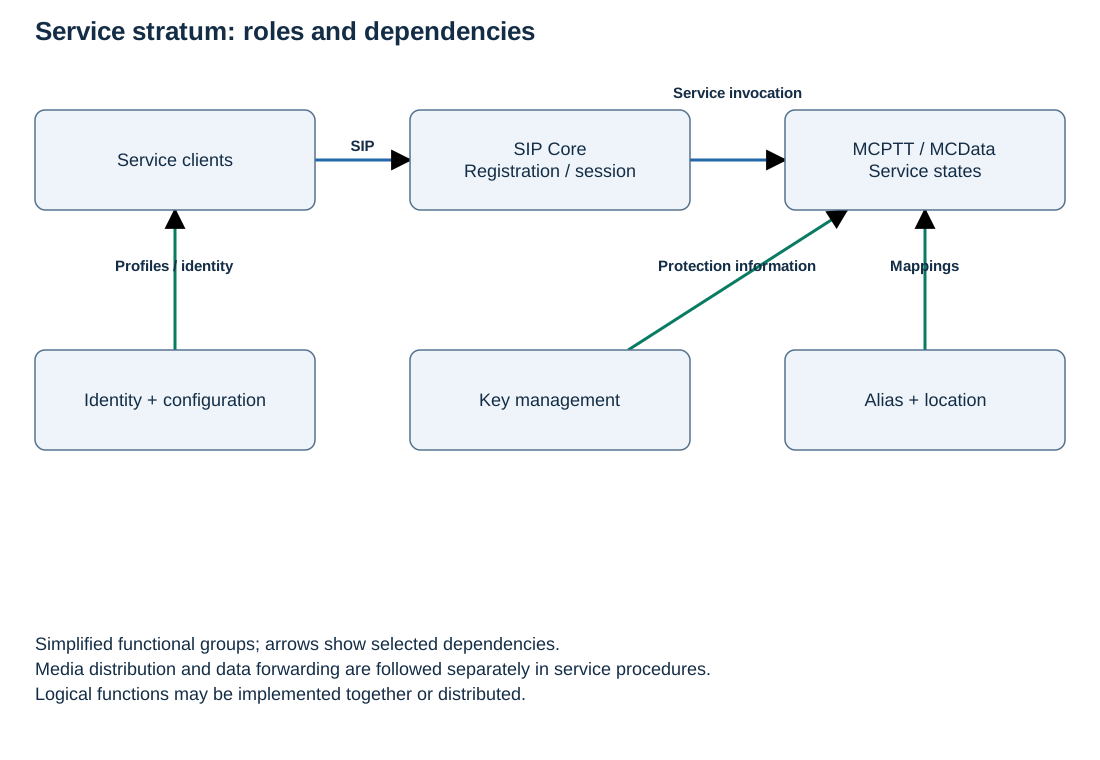
Four cooperating functional groups
The SIP Core supports registration and session control using SIP. MCX service functions process service-specific procedures: for voice, for example, participation and floor control; for data, management of data communication. Common management functions provide the required identities, configurations and security information. Clients use these functions on the user side. [S09, clauses 5 and 6]
| Function | Question in the Talbahn case | Observable consequence of a problem |
|---|---|---|
| Identity management | Who is requesting service access? | Service sign-in is rejected. |
| Configuration management | Which profile should the client use? | The client uses an incorrect or outdated service configuration. |
| Key management | Is the necessary protection information available? | Protected communication cannot be established or processed as intended. |
| Functional alias management | Which service user is reachable under the operational function? | A role-based call is misdirected or finds no destination. |
| Location management | What location information can a location-dependent function use? | Location-based recipient selection must be investigated. |
| MCPTT and media distribution | Who participates, who speaks and where does speech go? | Session, floor and audio states may be affected differently. |
| MCData | Which data session connects which endpoints? | An application request does not obtain a usable data connection. |
The table is an original diagnostic application of the architecture. It does not promise that every failure always causes exactly that symptom. Several functions may fail together or run on the same platform.
Distinguish control, media and management
Signalling controls communication. Media or user data is the content being transferred. Management maintains longer-lived information such as profiles and permissions. These three views explain why a successful SIP response alone is not a complete service test. A management error may also prevent the next call while an existing session continues; implementation-specific behaviour needs testing.
Lea therefore first signs in with her service identity. The client obtains or uses its approved profile. Service authorisation limits permitted use. During a call request, session control cooperates with the responsible MCPTT function. A later speaker change involves Floor Control, the function managing permission to speak. The media path then delivers voice data to the participants.
Boundaries of the component map
A dispatcher terminal is a workstation, not a synonym for the entire service platform. A Trackside Gateway integrates trackside applications. An Interworking Function translates defined functions to another communication system. A product called a Rail Application Server must also be classified by its actual functions. Dedicated lessons cover these elements while retaining the common map.
Check your understanding
After a profile change, Lea cannot use the service although IP packets arrive. Which two service areas do you investigate first, and why is another radio path insufficient?
Model answer
Check configuration as well as identity verification and service authorisation: does the new profile match the intended identity and permit the required services? Another radio path does not repair a shared incorrect configuration. Test this hypothesis against client and server events; the symptom alone does not establish the cause.
What to remember
The service stratum consists of cooperating functions with their own states. Relationships and procedures turn a component list into an architecture.
Your Talbahn case file
For each functional group, add an operator, a dependency and an observation point. Explicitly identify physical consolidation as an implementation choice.
Sources
S06 · UIC FRMCS SRS AT-7800
Version: 2.1.0, 30 April 2025 · Checked: 2026-10-11
Scope: System requirements, architecture, service/transport interaction and mobility. Functional Alias: 11.6/21.3; voice profiles: 24.2.3.3 and 24.3.3.2–4; TSCTRL: 6.4.1.3.
Limitations: The project baseline must specify the applicable parts.
Used in: 1.3, 2.4, 2.7, 2.9, 2.11, 2.13, 2.15, 2.16, 2.17, 2.18, 2.19, 3.2, 3.3, 3.16
S09 · ETSI TS 103 765-2: FRMCS Service Stratum
ETSI TS 103 765-2: FRMCS Service Stratum
Version: 1.1.1, January 2026 · Checked: 2026-10-11
Scope: Service architecture; SIP Core definition; registration and MC services.
Limitations: Do not equate IMS with SIP; the architecture allows the specified SIP Core alternatives.
Used in: 1.9, 2.1, 2.4, 2.5, 2.6, 2.7, 2.8, 2.9, 2.10, 2.14, 2.19, 2.22, 3.5, 3.16
Your progress is stored in this browser on this device.