Apply · 2.8
MCPTT: following a voice call
Time: about 10–13 minutes including the task; estimate
Guiding question: Which steps turn a button press into audible group communication?
Learning objective: You explain a selected MCPTT call with participation, floor and media.
Prerequisites: Previous lessons through 2.7, particularly the case file developed there.
Which call variant is being explained?
MCPTT covers different procedures. For this lesson's FRMCS context we consider an ad hoc group call with an on-demand session. Ad hoc here means selecting participants for the call from the intended information or criteria. In our simplified case, Lea, Niko and Amir's separate test device are explicitly the intended participants. Permission and reachability remain separate prerequisites. [S09, clause 6.2.1]
Group membership and affiliation are general MCPTT concepts. Affiliation associates a user with a group for its use in the relevant procedure. We do not derive an additional universally mandatory step for every FRMCS ad hoc call from this concept. The sequence diagram focuses on establishment, participation, a later floor change and media. Actual participant determination and message parameters are completed against the deployed profile.
Connect establishment to SIP
The voice client's request is processed through the intended SIP functions towards MCPTT service control. A successfully observed establishment segment permits subsequent service steps but does not prove every participant state. During the later speaker change, Amir requests the floor. Niko can hear speech only after permission is granted and media actually flows. Incorrect destination resolution, a rejected floor request and missing audio output are therefore different diagnostic cases.
Choose a concrete case
Lea wants to reach Niko and Amir as participants in an ad hoc group call. For this exercise, Amir uses a separate FRMCS test device; he does not simultaneously take over Lea's driver role. All three are authorised for the communication and selected for this ad hoc call. This teaching case does not assume a pre-existing group assignment.
We consider an on-network group call. This means the communication uses the intended network and service functions. Different session variants exist. Our example uses a newly established group call followed by a separately illustrated floor change. It is not a complete normative message sequence.
Separate preparation from an ongoing call
Before the call, usable transport, network and service registration, suitable configuration and permission for the intended call are in place. This preparation is not repeated for every press of the talk button. Even an authorised user can be temporarily unreachable.
Floor Control regulates permission to speak. According to the intended rules, it handles requests, allocation and release of the floor. Floor Request means a request for the floor. A participant uses it to ask for permission to speak. Floor Granted means notification of allocation. It confirms permission to speak, not reception of speech.
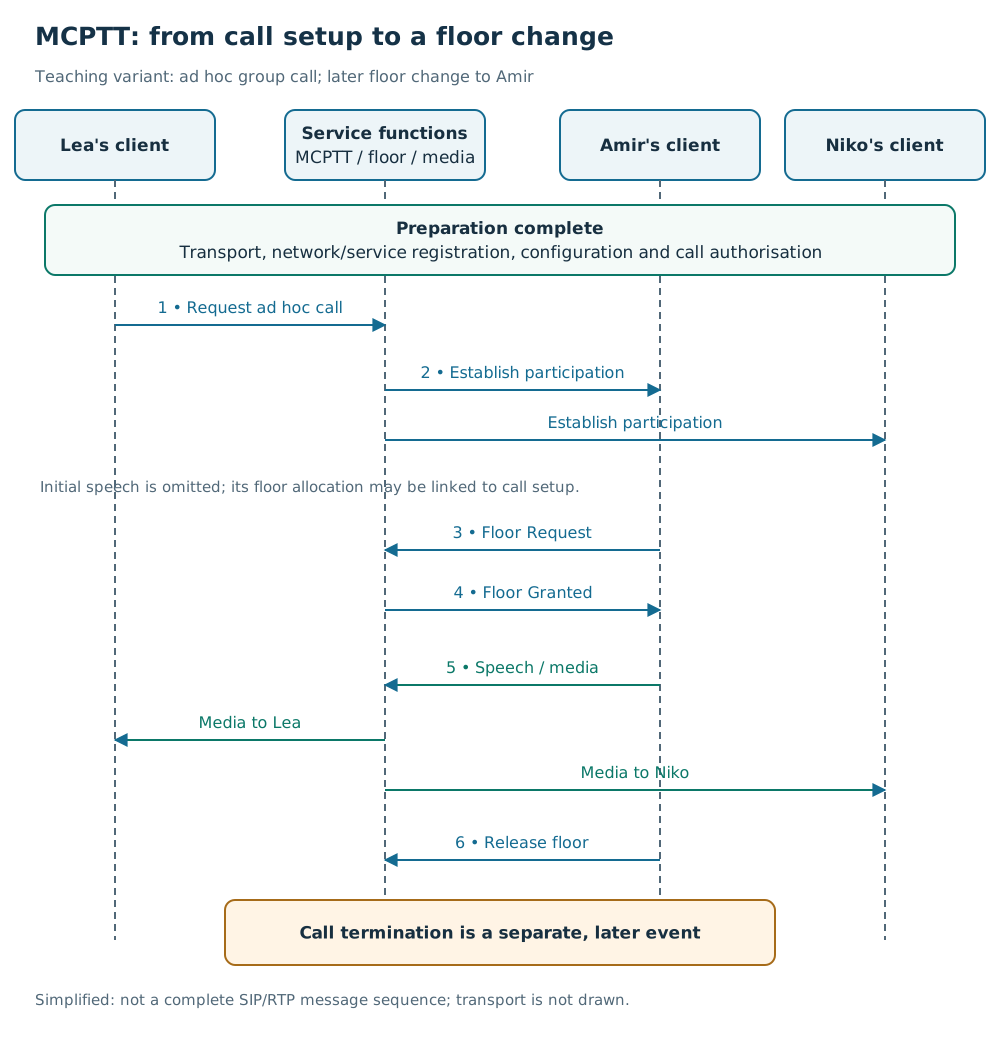
| Step | Observable event | What it does not yet prove |
|---|---|---|
| 1 | Lea initiates the group call; service functions handle establishment | That all intended participants are reachable |
| 2 | Session and participation states are established or confirmed | That anyone may already speak |
| 3 | For a floor change, Amir requests permission: Floor Request | That his request will be accepted |
| 4 | The responsible Floor Control function grants it: Floor Granted | That audio is actually transmitted and played |
| 5 | Amir sends speech; the intended recipients receive media | That their audio output is assigned correctly |
| 6 | Amir releases the floor; the call ends later | That floor release and call termination are the same event |
The protocol message is called Floor Granted; “Floor Grant” is a common shortened description. Depending on the call variant, the first floor allocation may be associated with call establishment. The separate Request/Granted sequence here deliberately shows a later floor change. [S23, S24]
Locate a fault systematically
If Amir is not granted the floor, missing speech should not immediately be blamed on transport. If permission is granted, media flow and audio output are checked separately. Receiving a successful SIP response does not cover these checks.
Priority affects handling of the exchange but replaces neither call permission nor radio coverage. Railway Emergency Communication, the specified railway hazard communication, adds defined recipient, area and priority conditions. An ordinary test group call does not demonstrate their fulfilment. [S05]
Check your understanding
The session is active. Amir has received Floor Granted. Niko hears nothing. Which two pieces of evidence are missing at a minimum? Why would it be wrong to draw complete re-registration at every floor change?
Model answer
Evidence of the appropriate media flow to the recipient and correct audio output is missing. Also check whether Amir is actually sending speech. Registration is an earlier network or service registration; changing the speaker within an existing session is a different process. The selected variant must be stated in the flow diagram.
What to remember
- Permission, participation, the floor and audio are separate states.
- Releasing the floor does not automatically end the call.
- A concrete teaching flow explains one variant, not all MCPTT procedures.
Your Talbahn case file
Record the six observations and add the failure case “floor granted, no speech”. In 2.20 we extend the case to GSM-R; in 3.4 we examine corresponding event records.
Sources
S05 · UIC FRMCS FRS FU-7120
Version: 2.1.0, 29 April 2025 · Checked: 2026-10-11
Scope: Functional requirements, identities, Functional Alias, voice and hazard communication.
Limitations: Teaching foundation, not evidence of complete product support.
Used in: 1.2, 1.3, 1.6, 2.7, 2.8, 2.15, 2.20, 3.2
S09 · ETSI TS 103 765-2: FRMCS Service Stratum
ETSI TS 103 765-2: FRMCS Service Stratum
Version: 1.1.1, January 2026 · Checked: 2026-10-11
Scope: Service architecture; SIP Core definition; registration and MC services.
Limitations: Do not equate IMS with SIP; the architecture allows the specified SIP Core alternatives.
Used in: 1.9, 2.1, 2.4, 2.5, 2.6, 2.7, 2.8, 2.9, 2.10, 2.14, 2.19, 2.22, 3.5, 3.16
S23 · 3GPP TS 23.379 / ETSI TS 123 379: MCPTT functional architecture and information flows
3GPP TS 23.379 / ETSI TS 123 379: MCPTT functional architecture and information flows
Version: 18.13.0, July 2025 · Checked: 2026-10-11
Scope: 5.3 affiliation; 7.3/7.4 functional model; 10.6 group calls.
Limitations: The teaching flow selects an on-network variant; not a universal message sequence.
Used in: 2.6, 2.8, 3.4
S24 · 3GPP TS 24.380 / ETSI TS 124 380: MCPTT media plane control
3GPP TS 24.380 / ETSI TS 124 380: MCPTT media plane control
Version: 18.5.0, May 2024 · Checked: 2026-10-11
Scope: Floor Control procedures and Floor Request / Floor Granted messages.
Limitations: The course abstracts protocol details and covers a later speaker change.
Used in: 2.8
Your progress is stored in this browser on this device.