Apply · 2.2
Transport stratum: radio access and 5G Core
Time: about 7–10 minutes including the task; estimate
Guiding question: How do radio access, connection control and packet forwarding cooperate?
Learning objective: You separate control functions from the user-data path in the 5G system.
Prerequisites: Previous lessons through 2.1, particularly the case file developed there.
Read the complete transport path
Radio access is called the Radio Access Network (RAN). A 5G base station is a gNB. It connects the terminal by radio to the other network functions. The 5G Core Network controls registration and data sessions, among other tasks, and provides packet forwarding. A PDU Session is the managed relationship through which a terminal can exchange data with a data network. It is not the same as an MCPTT call. [S13]
The Access and Mobility Management Function (AMF) handles access and mobility control. The Session Management Function (SMF) controls the data session. The User Plane Function (UPF) lies in the user-data path. The teaching path for user data is therefore terminal, radio access, UPF and reachable service or data endpoints. AMF and SMF control this relationship without every voice packet passing through both.
For diagnosis, Talbahn separates three observations: terminal registered; data session established; required service endpoint reachable. Service registration and call setup follow afterwards. This explains why a green network-registration indication is not complete communication readiness.
Compare control and user data
| Function | Task | What does not follow |
|---|---|---|
| AMF – Access and Mobility Management Function | Supports the participant's access and mobility management | An operational voice service is not yet fully ready |
| SMF – Session Management Function | Manages data sessions and controls associated forwarding conditions | It is not itself the general media-forwarding path |
| UPF – User Plane Function | Forwards user-data packets in the established path | It does not determine a message's operational meaning |
The complete architecture contains further functions. For this step, the distinction is enough: control establishes conditions, and user data travels in the appropriate path.
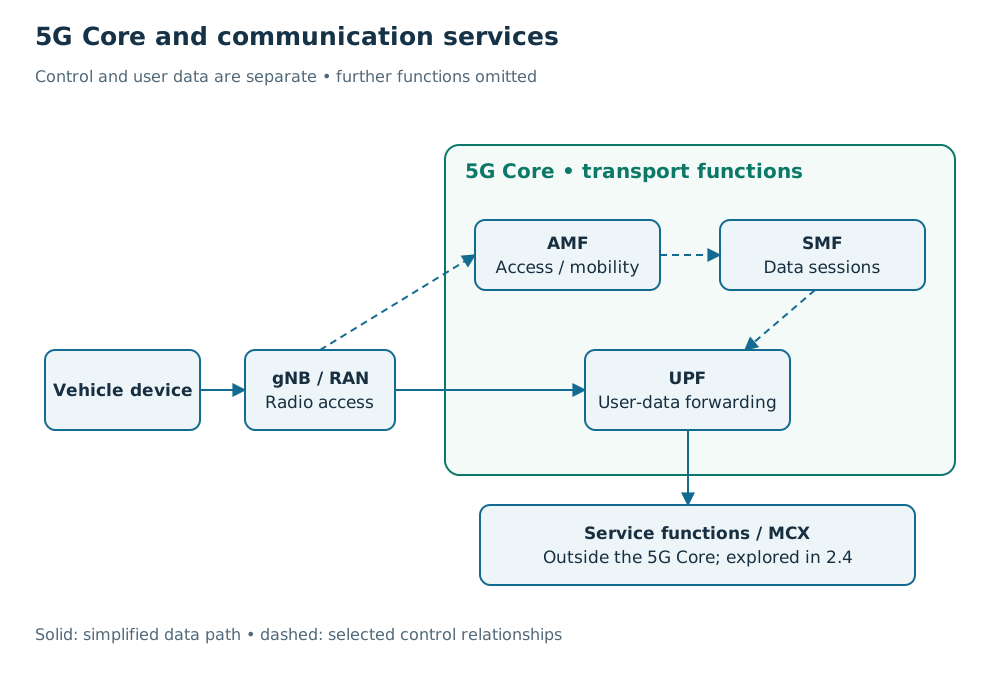
The diagram separates the core network from the service layer above it. The MCX services developed in 2.6 are not additional UPF or AMF functions.
Check your understanding
The device is network-registered but the service endpoint is unreachable. Which further transport states do you check, and which function lies in the user-data path?
Model answer
Check the established data session, its forwarding conditions and the path to the correct endpoint. The UPF forwards user data; AMF and SMF perform control tasks. Even subsequent endpoint reachability does not establish service authorisation.
What to remember
RAN and core perform different transport tasks. Control, data session and user-data path must work together.
Your Talbahn case file
Draw AMF, SMF and UPF with their different responsibilities. Mark registration, data session and endpoint reachability as separate observations.
Sources
S13 · 3GPP TS 23.501, published as ETSI TS 123 501
3GPP TS 23.501, published as ETSI TS 123 501
Version: 16.14.0, September 2022 · Checked: 2026-10-11
Scope: Section 5.7: QoS Flow, 5QI, ARP, GBR and Non-GBR.
Limitations: Explicit terminology reference, not presented as the latest edition or a complete FRMCS project baseline.
Used in: 2.2, 2.3, 2.10, 2.18
Your progress is stored in this browser on this device.